Home » Maritime Radio Room Clock
 [ Welkom ] [ Het waarom ] [ Examens ] [ Morse sectie ] [ QTH Locator ] [ Lijsten / Tabellen ] [ Referenties ] [ Link Sectie ]

Maritime Radio Room Clock
|
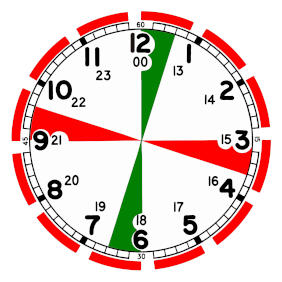
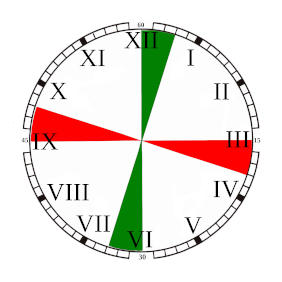
In the era before satellite communication, there was an international agreement that ships and coastal stations would observe two silent periods each hour in their radio communication. These periods were specifically reserved for emergencies. Red sector(15 + 3 minutes and 45 + 3 minutes): reserved for Morse code distress communications (500 kHz). During these periods, only SOS signals could be transmitted, or operators had to listen for distress calls. This prevented weak emergency signals from being drowned out by regular traffic. Green sector (12 + 3 minutes and 30 + 3 minutes): reserved for voice distress communications (2182 kHz), under the same principle — only MAYDAY calls or distress listening. |
History
The foundation of maritime distress communication was laid in the late 19th and early 20th centuries. Following the discoveries of Maxwell (1865) and Hertz (1887), Guglielmo Marconi developed the first practical wireless telegraphy in 1895, using Morse code — invented by Samuel Morse in 1835 — to send messages over radio waves. In 1901, Marconi achieved the first transatlantic wireless transmission.International agreements on distress signals emerged from the need for standardisation. In 1903, the first radiotelegraph conference proposed the SOS Morse signal, but the United Kingdom initially continued using CQD. After the Titanic disaster in 1912, SOS was adopted worldwide, and the first SOLAS Convention was established, designating 500 kHz as the official radiotelegraphy distress frequency and defining mandatory silence periods.
In 1927 and 1929, further radio conferences in Washington and Cairo refined these rules, including the use of automatic alarm signals, protective guard bands around the distress frequencies, and 24-hour listening requirements. For voice communications, 2182 kHz was designated, particularly for smaller vessels without a telegraph operator. This structure remained in use for decades, until the introduction of satellite communications and the GMDSS in the 1990s.
Online examples of maritime clocks.
|

|

|

|

|

|
|

|

|

|

|
Referenties/bronnen:
Clipart Morse Code Telegraph Operator
Make your own Maritime Radio Room clock
PA1JT Telegrafie een oud ambacht….(ZX ronde 31 januari 2021)
PI4HAL Bulletin Mei 2024
Wiki - Radio silence
Wiki - SOLAS
Wiki - SOS
[ Updates ] [ Disclaimer ] [ Copyrights ] [ PA4TON ] [ Website ] [ Cookies ] [ Contact ]
© 2025 pe1hvh


© 2025 pe1hvh